• Home
  • About
  • Music
  • Democracy in Music
  • Research
  • Contact
Sam Vance-Law
  • Home
  • About
  • Music
  • Democracy in Music
  • Research
  • Contact

I’ve been thinking for a while now about how we might be able to create music democratically. Where representation could be part of the makeup of a musical instrument. Where voting choices could result in sound.  

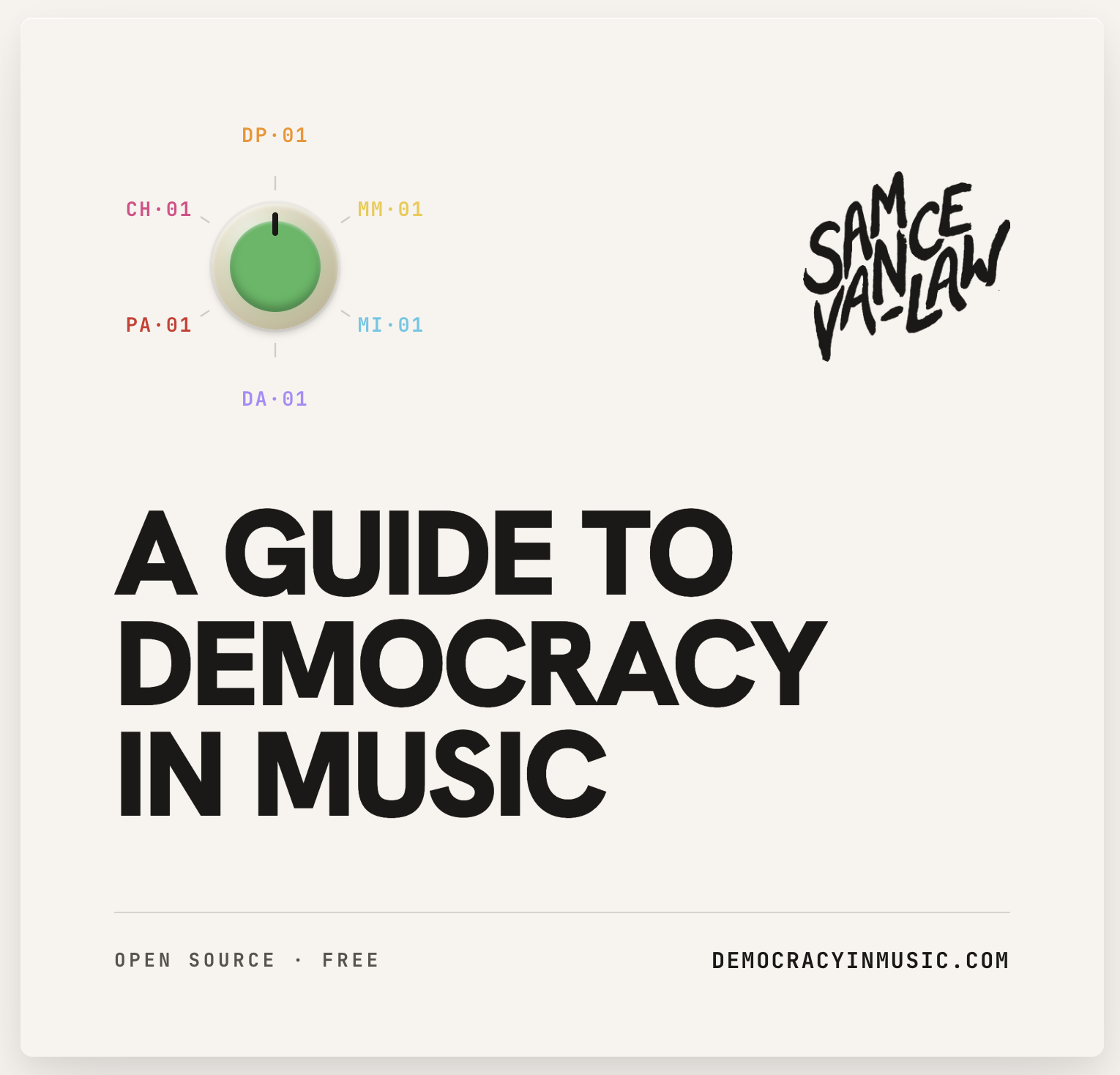
What follows is a set of prototypes for communal composition. Models for how large groups of people might create and own music together using democratic decision-making. Each one explores a different mechanism: averaging, spatial voting, quadratic voting, electoral systems, embodied movement, generational ownership. They are working demonstrations.

Here are links to the main index for this project, the full document explaining what it’s all about, and a one sheet for a quick overview.

None of these are finished pieces of music. They are instruments you can play with. All of them are single player for now (though you will find they all have ways of tallying votes). I will be building networked versions soon.

Piano

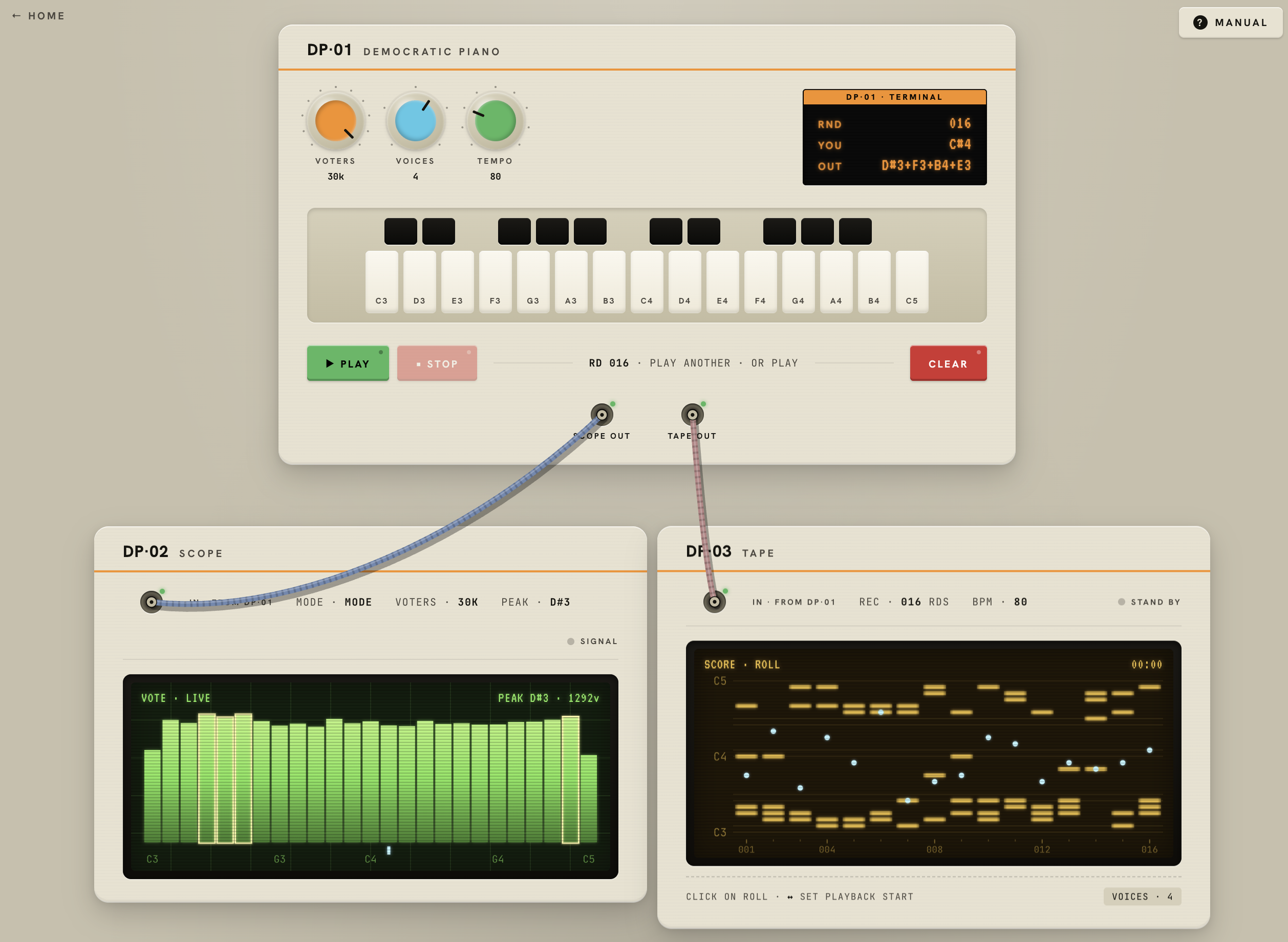
30,000 people sit at a piano. Each plays a note. The output is the statistical result of every choice. The simplest model is pure democratic averaging applied to pitch. Chords allow you to create harmony from proportional representation.

Play here

Miro

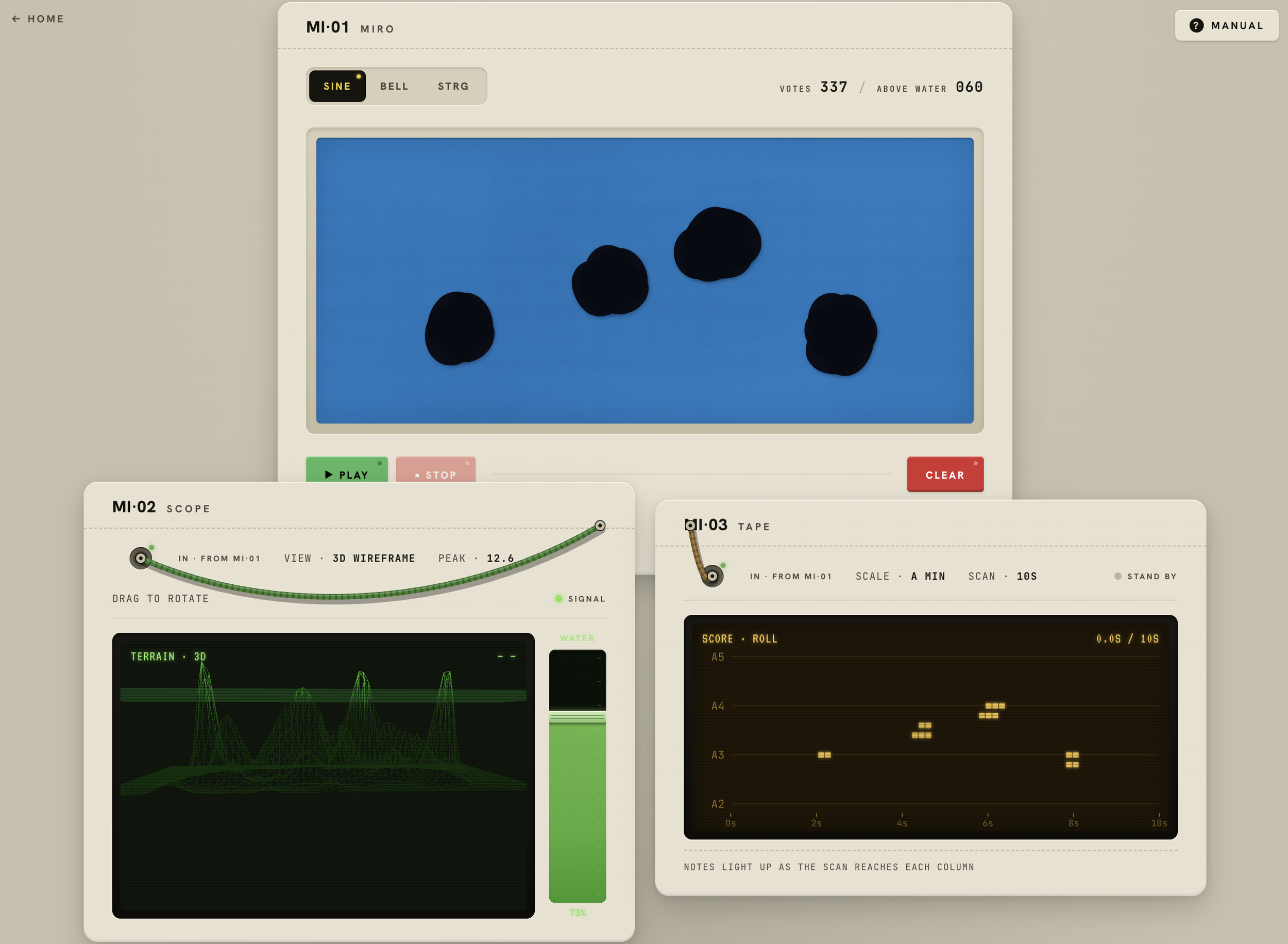
A shared canvas where each touch becomes a vote. Overlapping choices form peaks in a 3D landscape. The topography is sonified becoming sound. Inspired by Miró's Bleu II.

Play here

Mean Mode

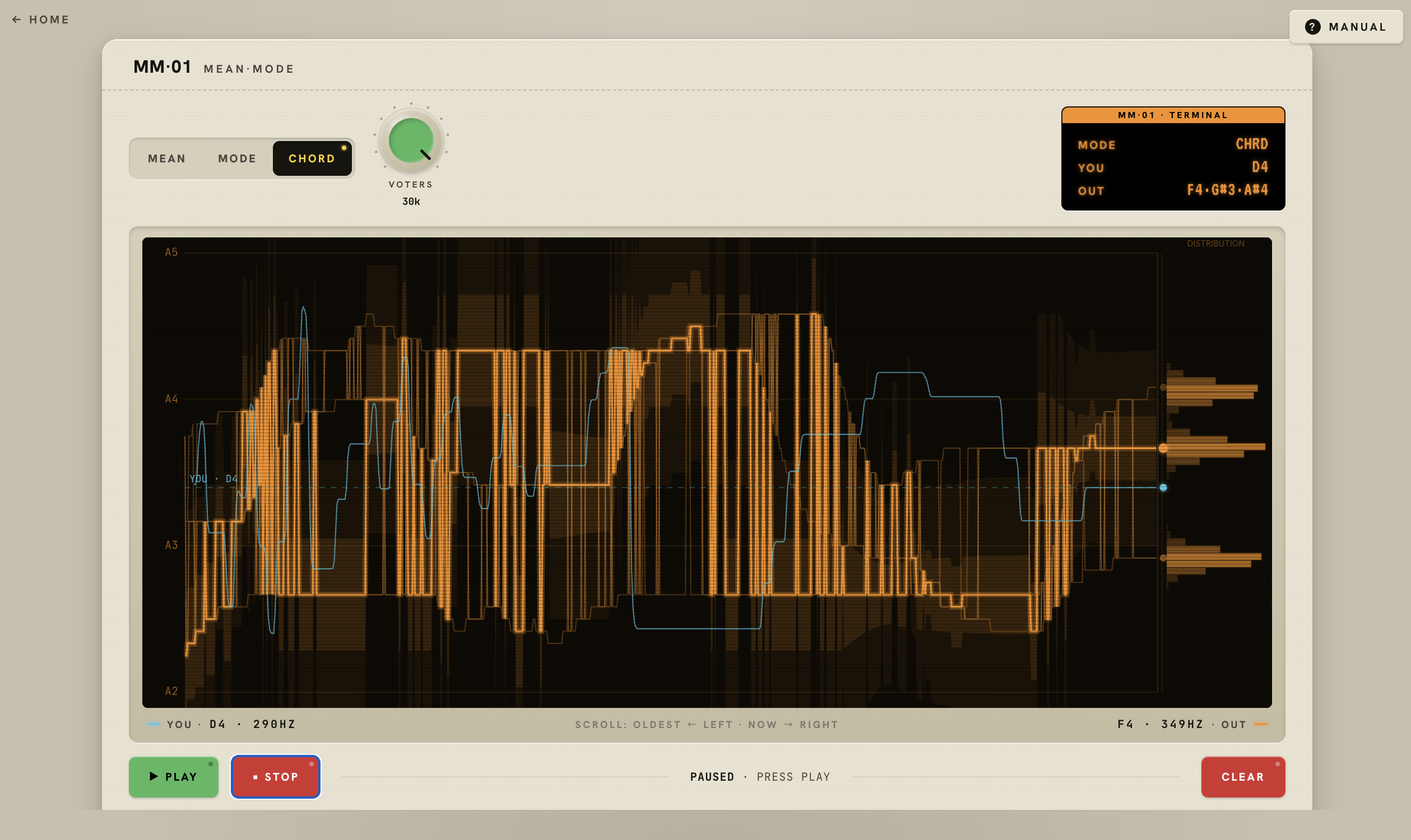
From discrete notes to a continuous frequency space. Thousands of votes cluster into a visible distribution. Switch between mean, mode, and chord to hear how the same votes produce different music depending on the aggregation method.

Play here

Assembly

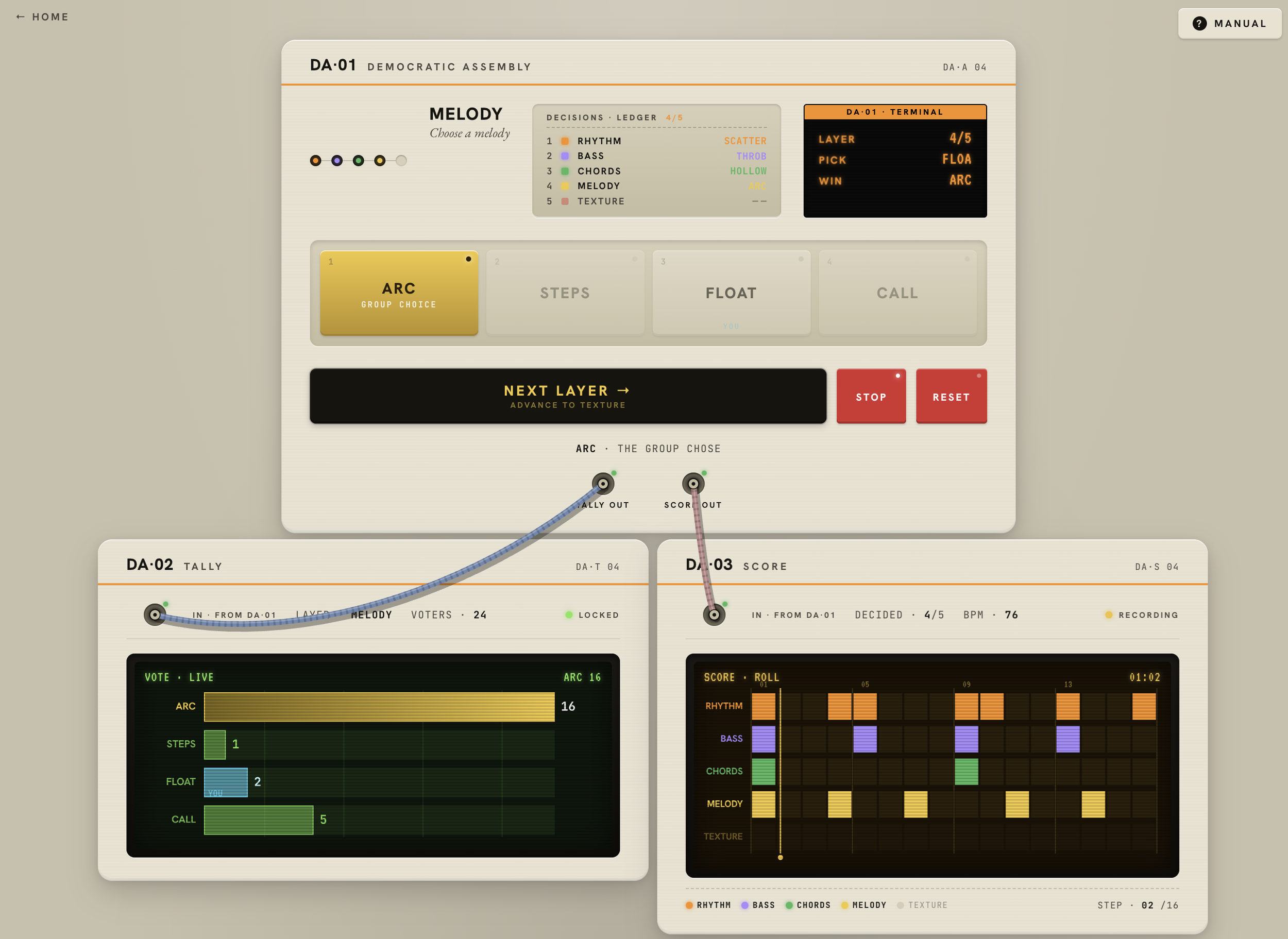
Five layers of pre-composed musical blocks. Participants spend voice credits to vote on which blocks to play. Concentrating votes costs quadratically more, so the output reflects not just majority preference but intensity of feeling.

Play here

Parliament

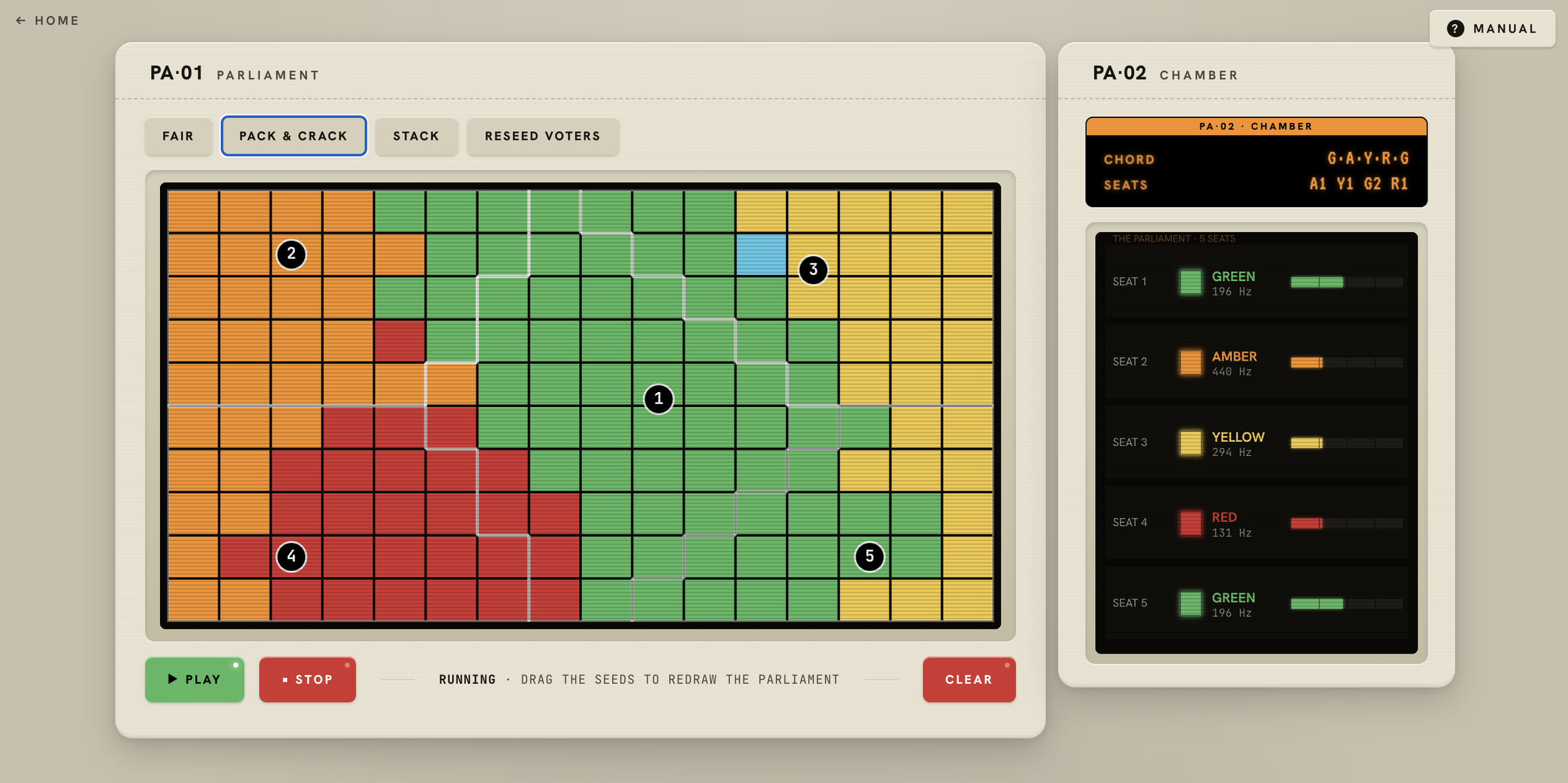
Vote for one of seven parties alongside 300 simulated citizens. Toggle between first past the post, proportional representation, and coalition. The votes stay the same. The system changes.

Play here

Choreography

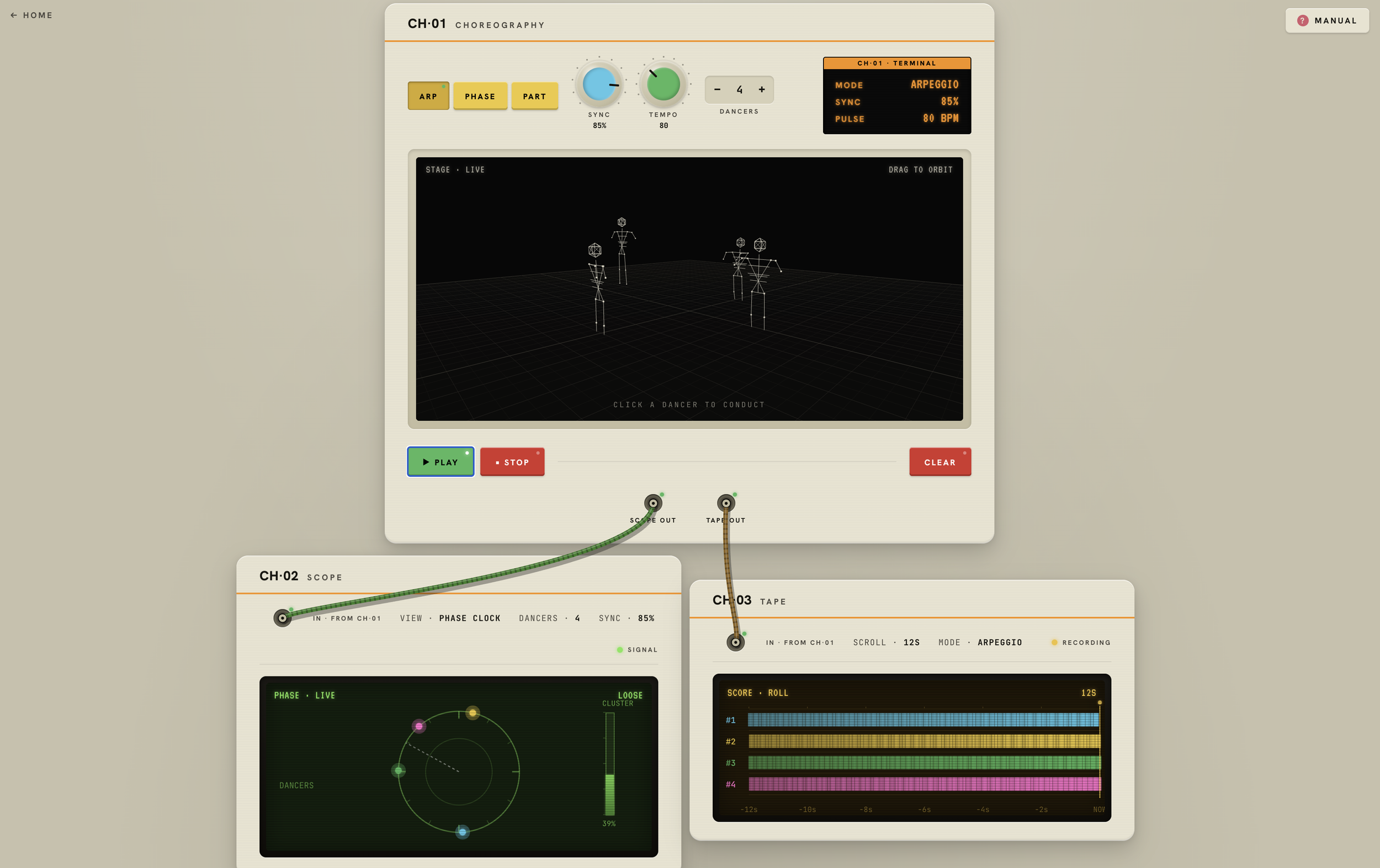
Democracy as physical representation in space. Cameras track dancers' movements and transcribe them into sound in real time. Dancers become co-composers in works that are new every single time.

Play here

Epoch

A composition that accumulates over days, months, generations. A neighbourhood builds a shared piece over a decade. A digital community of 50,000 whose work arrives in viral waves. A city of half a million over half a century.

Play here